
AI Readiness Assessment for Marketing Leaders
The AMOS AI Marketing Diagnostic
The AMOS AI Marketing Diagnostic is a structured AI readiness assessment designed to determine whether a marketing organization is prepared to adopt, govern, and scale artificial intelligence responsibly.
It establishes decision clarity before capital is committed, operating models change, or AI execution begins.
Designed for executive teams and marketing leaders responsible for high-stakes AI investment decisions.
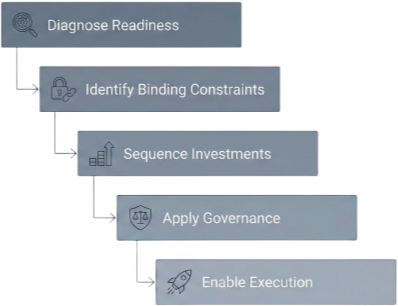
What Is an AI Readiness Assessment?
An AI readiness assessment determines whether a marketing organization has the structural capability to adopt, govern, and scale artificial intelligence responsibly.
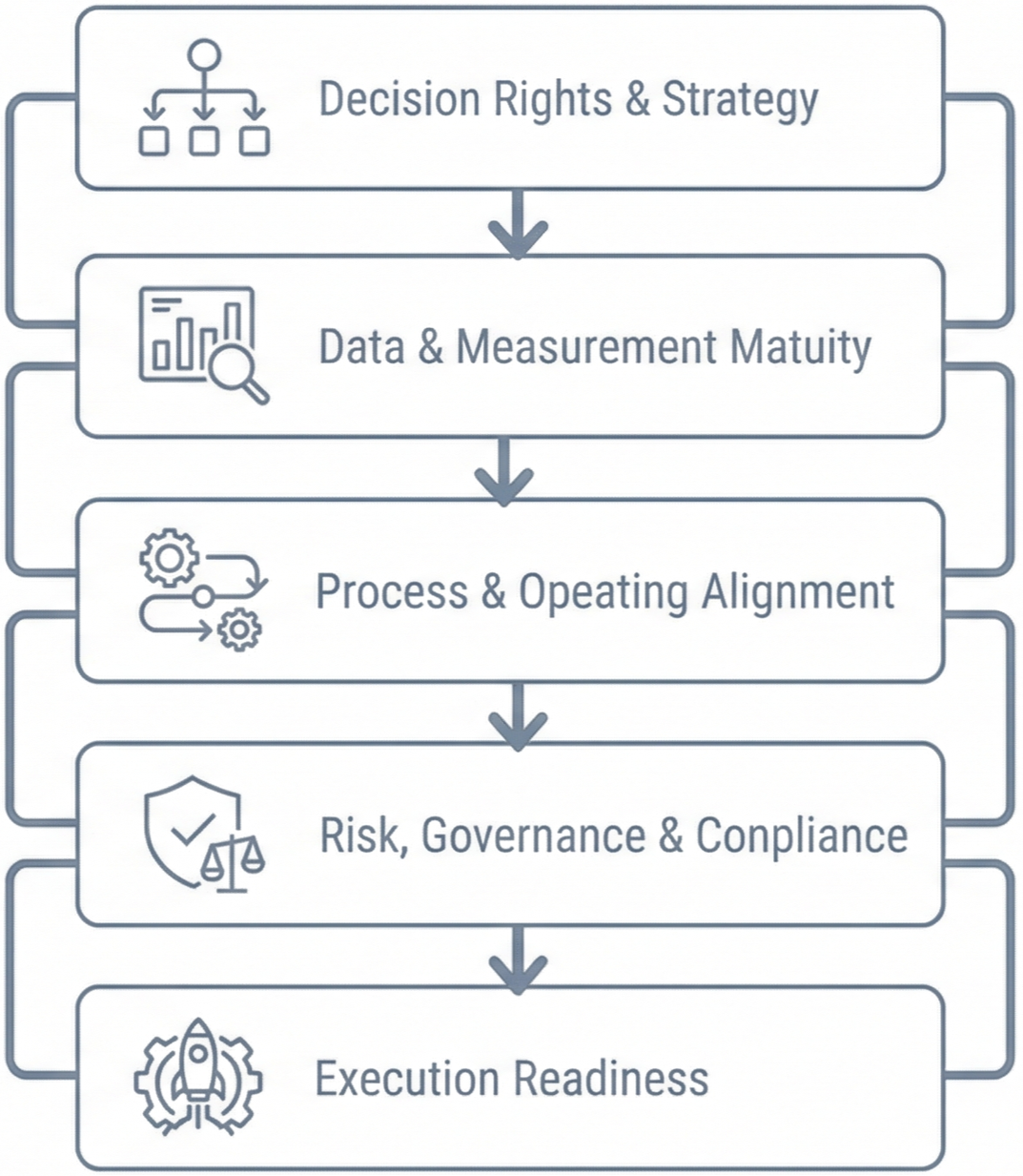
It evaluates the foundational conditions that enable effective AI adoption, including decision rights and strategy, data and measurement maturity, operating process alignment, governance and risk oversight, and execution readiness.
These structural capabilities must be established before capital is committed, operating models change, or AI activation begins.
For marketing leaders, an AI readiness assessment is not a technology audit. It is a governance and sequencing instrument that clarifies where AI can create leverage and where organizational constraints must first be resolved.
AI Maturity Model for Marketing
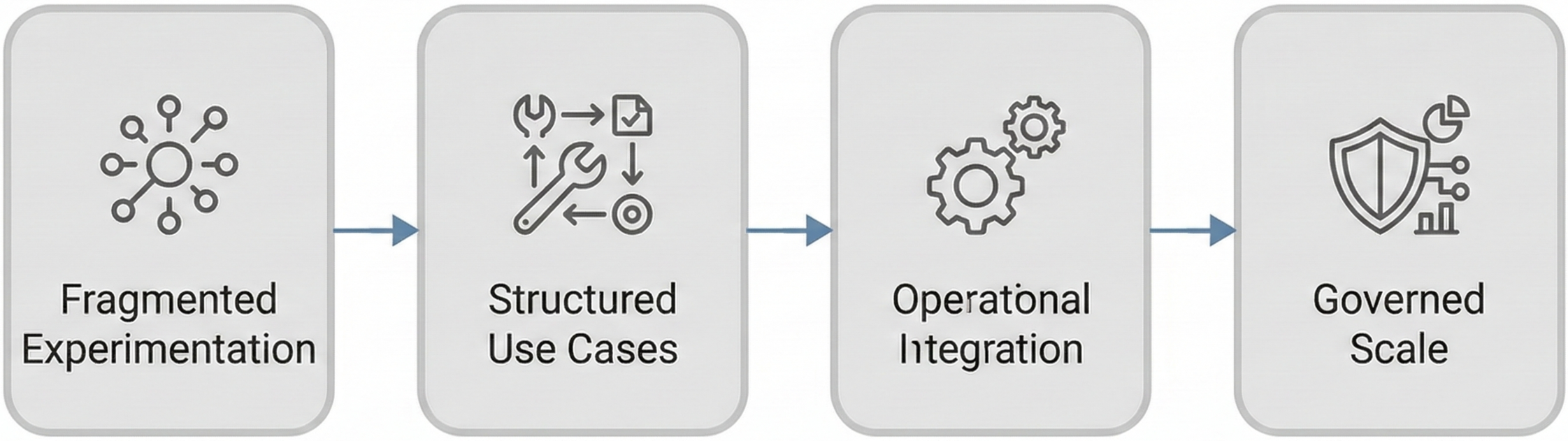
An AI maturity model defines the progressive capability stages through which marketing organizations advance as artificial intelligence is adopted and governed.
The AMOS Diagnostic establishes a structured maturity baseline across strategy clarity, governance discipline, execution readiness, and organizational alignment within the broader AI marketing operating model.
These stages typically progress from fragmented experimentation to structured use cases, operational integration, and ultimately governed scale.
Rather than assigning arbitrary scores, the model identifies binding constraints that determine whether AI investment should accelerate, sequence, or pause.
What the Diagnostic Is Not
The AI Marketing Diagnostic is intentionally narrow in scope. It is not designed to evaluate tools, optimize campaigns, or prescribe transformation plans.
The Diagnostic is not:
• A tool evaluation
• A campaign audit
• A maturity scoring exercise
• A transformation roadmap
The Diagnostic does not recommend platforms, optimize execution, or prescribe operating changes. Those decisions are intentionally deferred until diagnostic clarity is established across leadership.
What the Diagnostic Examines
Decision Architecture
How decisions are structured and governed
The Diagnostic evaluates how marketing decisions are structured across leadership, teams, and systems before automation or tooling is introduced.
Strategic/Operational Alignment
Whether strategy and execution readiness align
The Diagnostic examines whether strategic priorities, operating models, and execution capabilities align with economic reality.
System Integrity
Decision integrity across the marketing system
The focus is not performance in isolated channels, but whether the broader marketing system can support responsible AI adoption and scale.
Why Sequencing Matters
The Diagnostic introduces explicit stop conditions into marketing decisions.
When foundational alignment is missing, proceeding with execution, tooling, or automation increases cost and compounds risk. The Diagnostic identifies those conditions early and halts momentum until they are resolved.
Progression is earned, not assumed.

What the Diagnostic Produces
The Diagnostic produces a clear, shared view of where the organization is aligned, misaligned, and where progress should pause or proceed.
It surfaces decision gaps, sequencing risks, and structural constraints that materially affect marketing effectiveness, investment efficiency, and credibility with executive stakeholders.
The outcome is not a roadmap. It is clarity.
What Leaders Leave With
A readiness baseline
Where AI can and cannot work right now, based on operating realityA constraint map
What must change before scale is safe and credibleA sequenced investment logic
What to fund first, what to defer, and why
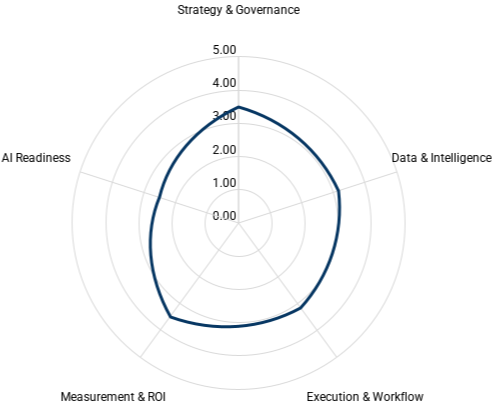
Example Diagnostic output showing relative readiness across core decision dimensions used to govern sequencing and investment decisions.
Why the Diagnostic Comes First
The Diagnostic prevents premature execution and misallocated capital.
AI investments should be sequenced based on evidence rather than momentum. The system governs what should happen next before AI activation and execution begin.
Without diagnostic clarity, initiatives rely on assumptions rather than shared evidence. The Diagnostic establishes leadership alignment first, so momentum is applied deliberately.
This is how the system protects focus, capital, and executive credibility.
Prevents premature automation
Aligns leadership before execution
Protects capital from mis-sequenced bets
AI Readiness Assessment FAQs
-
An AI readiness assessment in marketing evaluates whether a marketing organization has the structural capability to adopt, govern, and scale artificial intelligence responsibly.
-
AI readiness measures whether foundational conditions are in place for artificial intelligence to be introduced safely, while AI maturity measures how advanced and optimized those capabilities have become over time.
-
The duration of an AI readiness assessment depends on organizational complexity, but most executive-level assessments can be completed within several weeks.
-
An AI readiness assessment should be led by executive marketing leadership, typically the CMO or a cross-functional decision group responsible for governance and capital allocation.
How to Engage
The Diagnostic begins with a focused executive discussion to determine whether the system is appropriate for the organization at this stage.
If diagnostic clarity is not required, the engagement stops there.