
AI Marketing Execution Engines
Engines are constraint-removal mechanisms activated only after the Diagnostic confirms readiness and identifies the binding constraint.
Engines Follow Evidence
READINESS CONFIRMED | BINDING CONSTRAINT IDENTIFIED | EXECUTIVE ALIGNMENT ESTABLISHED

What AMOS Execution Engines Are, and Are Not
Engines exist to remove validated constraints. They are not preconfigured solutions, selectable capabilities, or predefined workstreams. An engine activates only when evidence confirms a binding constraint is limiting performance, and leadership is aligned to address it.
Engines are:
Decision-bound mechanisms designed to remove a single validated constraint. Each engine resolves one diagnosed constraint, nothing more. Activation occurs only after Diagnostic readiness is established and is governed by explicit entry and exit conditions.
Engines are not:
Offerings, packages, capability menus, implementation programs, or perpetual motions. Engines are not selected, stacked, or deployed based on preference, urgency, or perceived best practice. If no constraint is present, no engine activates.
Why Engines Are Not Predefined
Predefining Engines assumes the constraint is already known. In practice, this is where most marketing operating systems fail. Teams commit to action before understanding what is actually limiting performance. AMOS is explicitly designed to prevent this failure mode.
When Engines are selected in advance, effort targets symptoms, not causes. Resources are deployed based on familiarity, urgency, or organizational habit rather than evidence. The result is motion without resolution.
By design, AMOS withholds Engine activation until Diagnostic evidence establishes the binding constraint. This ensures activation is precise, proportional, and aligned to the decision that actually matters.

What an Engine Does
An Engine exists to remove a single diagnosed constraint validated through the AMOS Diagnostic. It concentrates decision-making, resources, and leadership attention on the factor most directly limiting progress.
An Engine does not optimize broadly or improve everything at once. Its role is to change the condition preventing the system from moving forward. Once that condition is resolved or no longer binding, the Engine exits.
In this way, Engines function as controlled interventions inside the AMOS operating system. They are activated with intent, governed by evidence, and constrained by explicit entry and exit conditions.
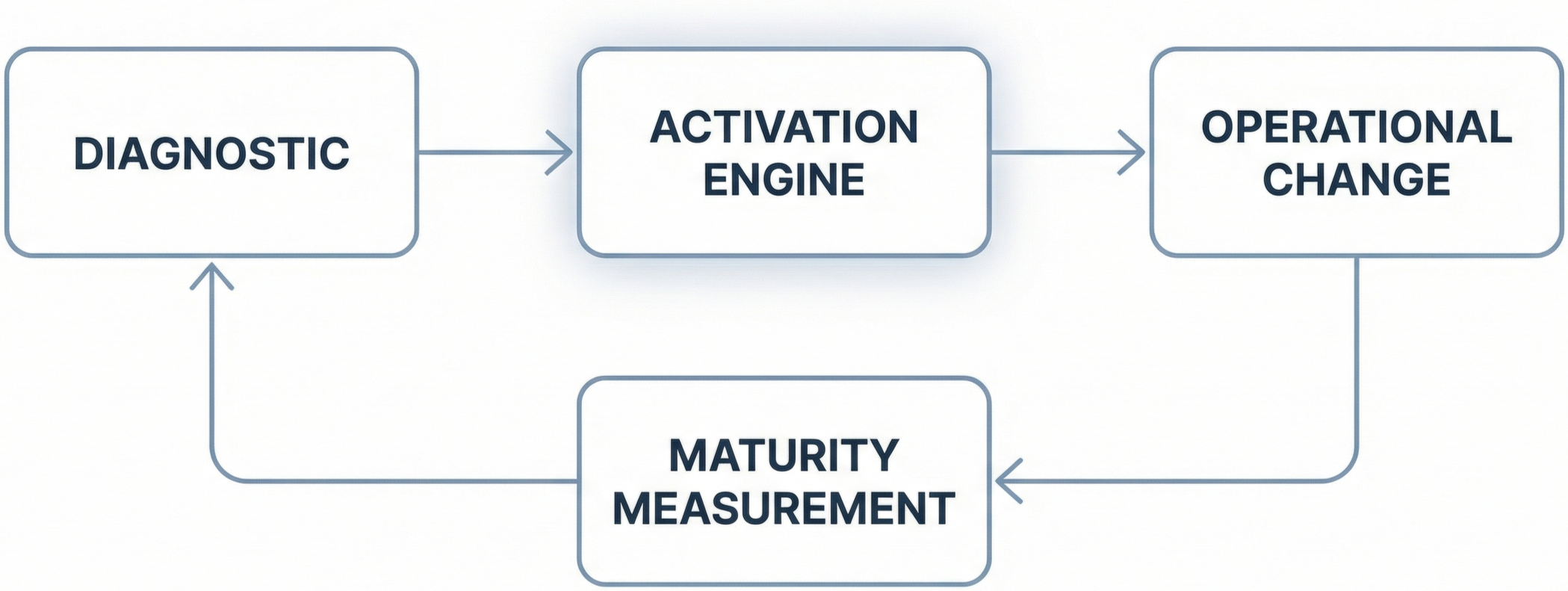
SYSTEM SEQUENCE
System sequencing: Diagnostic clarity → governed Engine activation → operational change.
Activation Logic
Engines activate only when three conditions are satisfied.
These conditions protect decision quality before execution begins.
Readiness Established
The system is capable of acting
AMOS confirms sufficient signal quality, decision ownership, and organizational context to support action.
Binding Constraint Identified
A real constraint is proven
An Engine activates only when evidence demonstrates a specific constraint is materially restricting progress.
Executive Alignment Locked
Leadership commits to the decision
Leadership agrees the diagnosed constraint is the correct problem to address and that conditions support action.
Hard Stop: If any condition is unmet, activation does not occur.
Why This Discipline Matters
Discipline Prevents Motion Without Progress
AMOS enforces Diagnostic-first activation and explicit stop conditions to prevent effort without precision. Action follows understanding, not urgency. Resources change outcomes instead of creating noise.
What Changes Inside the Organization
This discipline reduces wasted effort, limits churn, and preserves executive confidence in decision quality. Engines activate only when warranted, exit when resolved, and never operate by default.
What This Means for Leadership Teams
Fewer initiatives. Clearer decisions. Tighter control over effort. If no Engine activates, that outcome stands. In AMOS, restraint is a feature, not failure. Leaders gain confidence that action reflects evidence over pressure.
Your Next Step: Understand the System
Engines activate only when readiness is established and constraints are understood. The Diagnostic determines whether action is warranted and what happens next.