
How AMOS Works
AMOS is not deployed, installed, or rolled out. It is followed.
As an AI marketing operating system, AMOS establishes the structure through which AI decisions are defined, sequenced, and governed inside the marketing operating model before execution begins.
Clarity precedes commitment.
Each component exists to prevent premature execution, reduce downstream risk, and ensure AI investments proceed only when governance conditions and readiness thresholds are met.
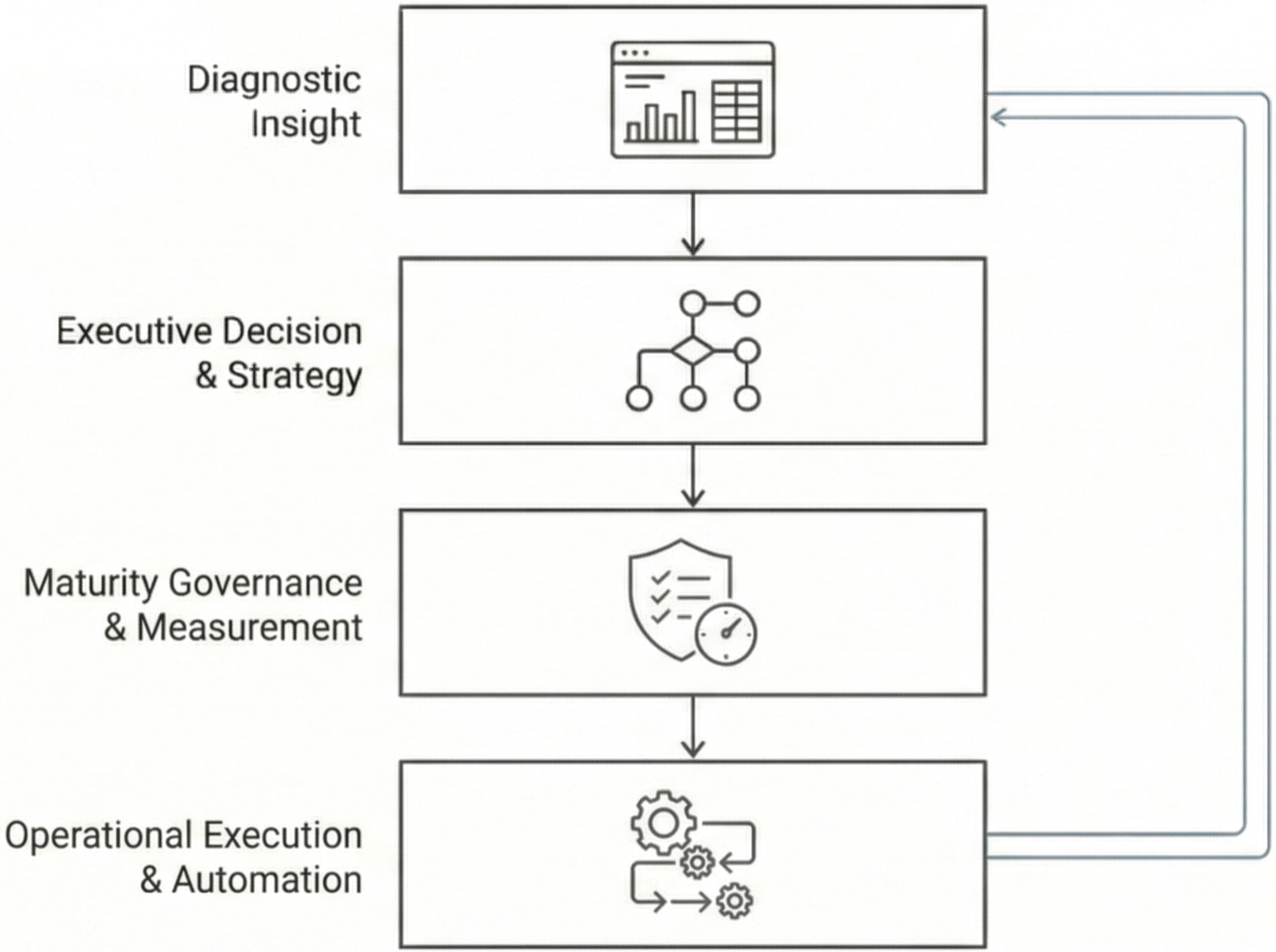
Diagnostic → Decision → Governance → Execution
A Decision-Led Operating Sequence
AMOS works through a deliberate, three-part sequence designed to protect decision quality before resources, teams, or technologies are committed. Each phase answers a distinct executive question, and no phase is skipped.
The system begins with diagnosis, moves to executive interpretation, and only then enables targeted activation. This sequence ensures that AI is applied with intent, not urgency. This governance-first sequencing model protects capital allocation and organizational credibility in AI marketing investment.
Phase 1 — Diagnostic
Purpose: Establish objective clarity
The Diagnostic evaluates readiness, constraints, and risk across strategy, data, operations, and governance. It creates a shared, evidence-based view of current-state conditions before solutions are considered.
Phase 2 — Executive Readout
Purpose: Translate insight into decision
Diagnostic findings are synthesized into executive-level implications. This phase frames tradeoffs, sequencing priorities, and “do / defer / avoid” decisions so leadership can commit with confidence.
Phase 3 — Engine Activation
Purpose: Enable only what is warranted
Only after decisions are made are AMOS Engines activated. Each Engine is scoped, sequenced, and governed based on Diagnostic findings, never as a default or bundle.
What AMOS Does Not Do
AMOS is intentionally constrained. The system is designed to prevent common failure modes in AI adoption by explicitly excluding activities that create speed without clarity, or execution without authorization.
Not a Production Engine
Does not generate content, campaigns, or creative
Execution artifacts are outcomes of decisions, not inputs. AMOS determines whether those activities should occur and under what conditions.
Not a Replacement Layer
Does not replace teams, agencies, or platforms
AMOS governs decisions across people, partners, and technology. It does not perform work on their behalf or override organizational accountability.
Not a Speed Multiplier by Default
Does not accelerate execution by default
Speed is a consequence of clarity, not a substitute for it. In some cases, the correct outcome is deferral or avoidance until clarity is established.
Principle: If the decision should not be made, the system does not proceed.
How Engagement Works
AMOS engagements are time-boxed and decision-led. The goal is not to “implement AI,” but to make the right decisions, in the right order, with clear ownership and governance.
1 — Entry Point: The Diagnostic
Every engagement begins with the Diagnostic. It establishes readiness, constraints, and risk before activation. If conditions are insufficient, the correct decision is to defer or avoid.
2 — Cadence: Diagnose → Readout → Authorize
The Diagnostic is followed by an executive readout that frames implications, tradeoffs, and sequencing. Only after leadership authorizes a path forward are Engines activated and governed.
3 — Outputs: Decisions and Guardrails
AMOS produces executive-grade decisions: what to do, what to defer, what to avoid, and what must be true before proceeding. The outputs are designed to guide teams and partners without ambiguity.
4 — Stop Conditions: When the System Halts
AMOS does not advance on momentum. If the Diagnostic reveals unresolved constraints, governance gaps, poor data, unclear ownership, or misaligned priorities, the system pauses until they are resolved.
AMOS Is Designed to Stop
AMOS exists to enforce decision discipline. Once clarity is achieved, decisions are authorized, and ownership is clear, the system steps back. It does not persist for its own sake or create dependency.
The goal is not perpetual engagement. It’s correct decisions.