
AI in Marketing: Who Owns the Operating Model?
Executive Framing
AI in marketing is no longer a tooling question. It is an ownership question.
As AI initiatives expand across demand generation, content production, analytics, and personalization, organizations are discovering a structural tension: everyone is participating, but no one is clearly accountable for the operating model.
The result is diffusion of authority, fragmented experimentation, and governance gaps that compound over time.
The question is not who buys the tools.
The question is who owns the system.
The Organizational Reality
In most enterprises, AI adoption in marketing unfolds along familiar lines:
The CMO sponsors innovation.
The CIO governs technology and risk.
Data teams manage infrastructure.
Individual marketing leaders experiment within their domains.
This appears collaborative.
It is structurally ambiguous.
When ownership of the operating model is unclear:
Decision rights become informal.
Investment sequencing becomes opportunistic.
Risk oversight becomes reactive.
Measurement standards drift across teams.
AI becomes activity, not architecture.
And architecture is what determines durability.
Why the Ownership Debate Is Misframed
The common debate is framed as:
Should AI in marketing sit with Marketing, IT, or a centralized AI function?
This is the wrong question.
Operating model ownership is not the same as tool ownership.
Technology stewardship can reside in IT.
Data governance can reside with a data office.
Use case experimentation can occur within marketing teams.
But the marketing AI operating model, the structure that governs how AI integrates into planning, execution, risk control, and measurement, requires accountable executive ownership.
Without a single point of accountability, governance fragments.
Fragmentation erodes maturity.
The Structural Risk of Diffused Authority
When operating model ownership is diffuse, several predictable patterns emerge:
1. Investment Inflation Without Portfolio Discipline
Use cases multiply.
Tools accumulate.
Pilot programs persist beyond their strategic value.
Without an accountable executive steward, AI becomes an expanding cost layer rather than a structured capability.
2. Decision Rights Drift
Teams make AI-related decisions based on proximity, not authority.
This includes:
Model deployment decisions
Vendor selection
Automation scope
Risk acceptance thresholds
Decision drift introduces structural inconsistency.
3. Governance After the Fact
Risk oversight becomes retrospective.
Legal reviews occur late.
Compliance frameworks lag adoption.
Executive reporting remains output-focused rather than structure-focused.
Governance becomes reactive rather than embedded.
Reframing the Question
The correct framing is:
Who is accountable for the AI-enabled marketing operating model?
Not:
Who experiments with AI?
Who manages the tools?
Who builds the models?
Ownership of the operating model means accountability for:
Structural integration across planning and execution
Investment prioritization discipline
Measurement standards
Governance design
Decision-right clarity
Risk oversight integration
This is executive territory.
A Governance-Oriented Ownership Model
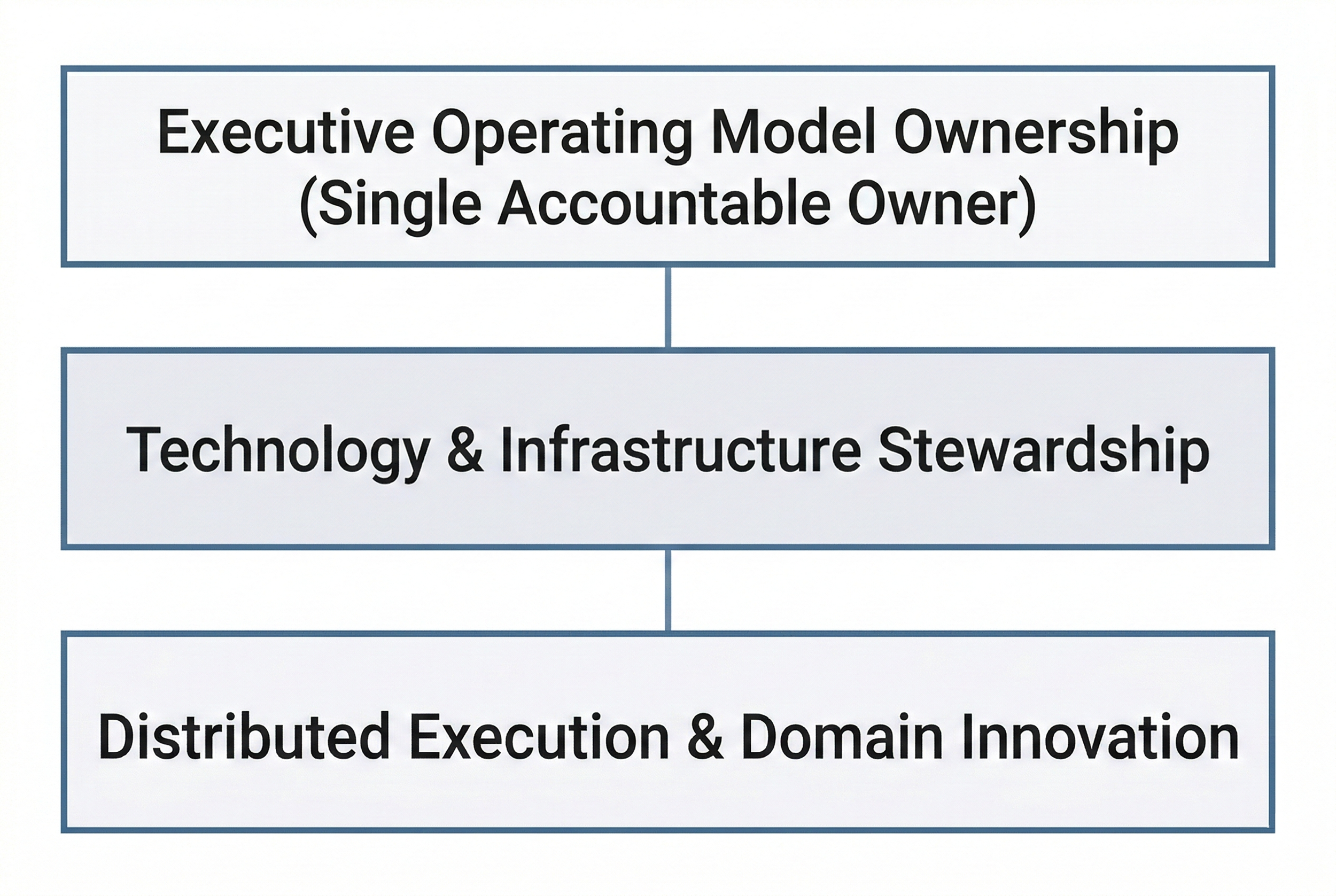
AI-enabled marketing systems require clear role delineation across three layers:
1. Executive Accountability (Single Owner)
One executive must hold structural accountability for:
Operating model design
Cross-functional integration
Portfolio sequencing
Risk governance alignment
Maturity progression
In most enterprises, this should reside with the CMO or a delegated senior marketing operator reporting directly to the CMO.
Accountability cannot be committee-based.
2. Technology & Infrastructure Stewardship
Typically owned by CIO / CTO / Data leadership.
Responsibilities include:
Architecture integrity
Security and compliance controls
Infrastructure scalability
Vendor evaluation standards
This is stewardship, not operating model ownership.
3. Distributed Execution & Domain Innovation
Marketing leaders experiment and operationalize within governed boundaries.
They do not define the system.
They operate within it.
Clear boundaries reduce ambiguity.
Decision Rights as Structural Control
Operating model ownership must be reinforced through explicit decision-right design.
This includes clarity on:
Who authorizes new AI investments
Who approves deployment into customer-facing workflows
Who defines measurement standards
Who determines acceptable risk thresholds
Who evaluates maturity progression
Absent explicit decision-right architecture, ownership remains theoretical.
And theoretical ownership does not produce structural discipline.
Executive Implications
For CMOs and transformation sponsors, this article leads to a practical conclusion:
AI in marketing cannot mature under distributed accountability.
If no one owns the operating model:
Portfolio discipline erodes.
Governance fragments.
Measurement lacks integrity.
Executive reporting becomes superficial.
AI becomes activity without architecture.
Executive ownership of the operating model is not about control.
It is about structural coherence.
Closing Insight
Organizations often ask whether AI should sit in marketing, IT, or a centralized innovation group.
The more important question is whether anyone owns the system.
AI will continue to expand across marketing functions.
Without accountable operating model ownership, expansion becomes entropy.
Mature organizations do not merely adopt AI.
They assign ownership of the architecture that governs it.
