
Measuring AI Marketing Maturity: How CMOs Assess Structural Progress
The Illusion of AI Progress
AI activity is not the same as AI maturity.
Organizations often equate experimentation volume with advancement. More pilots, more tools, more automation initiatives. Yet structural maturity remains unclear.
CMOs frequently face a more difficult question:
Are we actually progressing, or are we simply expanding experimentation?
Without a defined maturity model, AI adoption becomes difficult to evaluate objectively. Budget increases may mask structural fragility. Tool proliferation may conceal governance gaps.
Maturity must be measured structurally, not tactically.
What Is AI Marketing Maturity?
AI marketing maturity is the degree to which AI capabilities are structurally governed, sequenced, measured, and integrated within the marketing operating model.
Maturity is not defined by the number of AI tools deployed. It is defined by:
Governance clarity
Decision rights discipline
Portfolio alignment
Measurement rigor
Risk oversight
Executive accountability
True maturity reflects system capability, not experimentation velocity.
Why CMOs Need a Formal Maturity Model
Without a structured model:
Progress cannot be benchmarked
Investment decisions lack comparative clarity
Scaling thresholds are undefined
Governance improvements are difficult to measure
A maturity framework allows executive leadership to evaluate:
Current structural state
Capability gaps
Risk exposure
Sequencing readiness
Scale eligibility
It converts ambiguity into assessable progression.
The Five Stages of AI Marketing Maturity
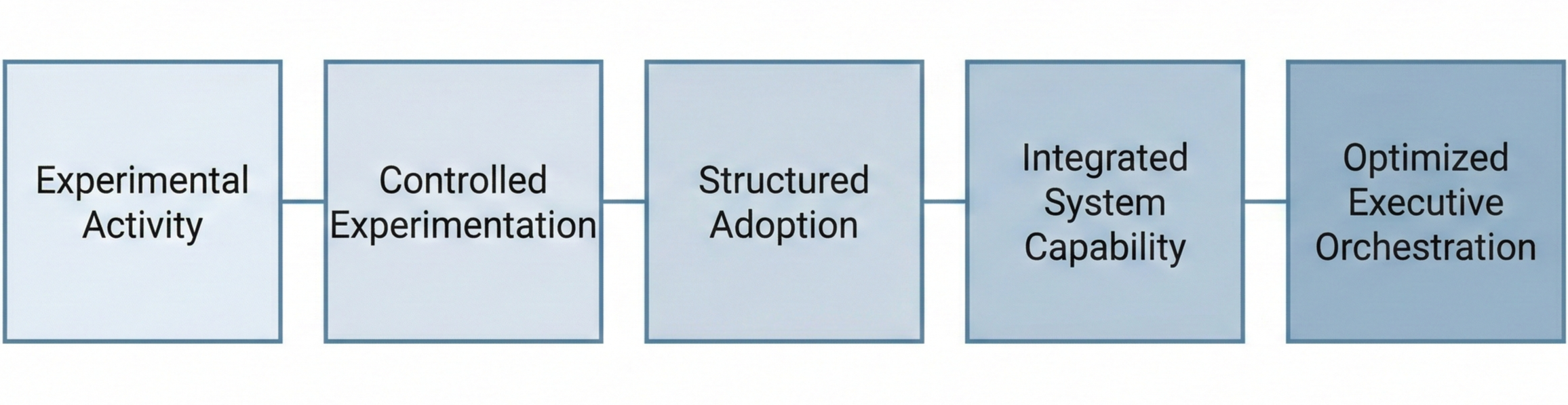
The following five-stage model reflects structural evolution, not technical sophistication.
Stage 1: Experimental Activity
Characteristics:
Isolated AI pilots
Tool adoption driven by teams
Limited governance oversight
Inconsistent measurement standards
Undefined executive ownership
At this stage, activity is high but structural integration is low.
Risk exposure is often underrecognized.
Stage 2: Controlled Experimentation
Characteristics:
Emerging oversight mechanisms
Initial approval processes
Early performance benchmarks
Limited cross-team coordination
Informal portfolio awareness
Governance begins to form, but sequencing remains reactive.
Stage 3: Structured Adoption
Characteristics:
Defined decision rights
Portfolio-level prioritization
Diagnostic-first sequencing
Formalized measurement standards
Identified risk controls
AI initiatives align with strategic objectives. Scaling begins under discipline.
Stage 4: Integrated System Capability
Characteristics:
Cross-functional orchestration
Portfolio governance with stage-gates
Performance instrumentation embedded in operating cadence
Defined escalation pathways
Executive accountability formalized
AI operates as an embedded capability within the marketing system.
Expansion occurs through controlled scaling.
Stage 5: Optimized Executive Orchestration
Characteristics:
Continuous maturity assessment
Dynamic resource reallocation
Portfolio-level performance benchmarking
Proactive risk monitoring
AI embedded in strategic planning cycles
AI is no longer an initiative category. It is integrated into the marketing operating architecture.
At this stage, maturity is sustained rather than episodic.
How CMOs Assess Structural Progress
To evaluate maturity, CMOs should examine:
Are decision rights formally documented?
Is AI investment managed as a portfolio?
Are performance metrics standardized across initiatives?
Are governance reviews recurring and structured?
Is risk oversight proactive rather than reactive?
If these conditions are uneven, maturity remains transitional.
Progress should be measured against structural discipline, not output volume.
When to Conduct a Formal Maturity Assessment
A structured assessment is warranted when:
AI investment budgets are expanding
Tool proliferation increases coordination complexity
Risk exposure becomes board-visible
Performance measurement lacks comparability
Executive accountability remains ambiguous
Maturity assessment should precede aggressive scaling.
Executive Summary
AI activity does not equal AI maturity.
Maturity is defined by governance, sequencing, and accountability.
A five-stage model clarifies structural evolution.
Controlled experimentation is not system capability.
Integrated governance distinguishes scaling from expansion.
CMOs must measure structural progress, not tool adoption volume.
AI maturity is achieved when governance discipline and execution architecture operate together.
Structural progress is measurable.
Without measurement, expansion becomes assumption.
