
The AI Marketing Operating Model: Why Tools Alone Do Not Create Maturity
Artificial intelligence is accelerating inside marketing organizations. Investment is increasing. Expectations are rising. Pilots are expanding.
In most organizations, however, AI adoption is advancing faster than structural alignment.
Tools are implemented before decision rights are defined. Use cases launch before sequencing is clarified. Investment precedes governance.
This does not create maturity. It creates unmanaged exposure.
An AI marketing operating model determines whether AI becomes a scalable capability or a source of fragmentation and risk.
Organizations that structure first scale responsibly. Organizations that deploy first restructure later.
What Is an AI Marketing Operating Model?
An AI marketing operating model is a structured governance framework that defines how AI initiatives are prioritized, sequenced, approved, implemented, and measured within a marketing organization.
It is not a tool stack.
It is not a vendor ecosystem.
It is not a pilot roadmap.
It is decision infrastructure.
An operating model clarifies:
Decision authority
Sequencing logic
Readiness requirements
Risk controls
Performance accountability
Without this structure, AI remains experimental regardless of investment level.
This framework aligns directly with the AMOS Five-Layer Operating Model described on the Engines page.
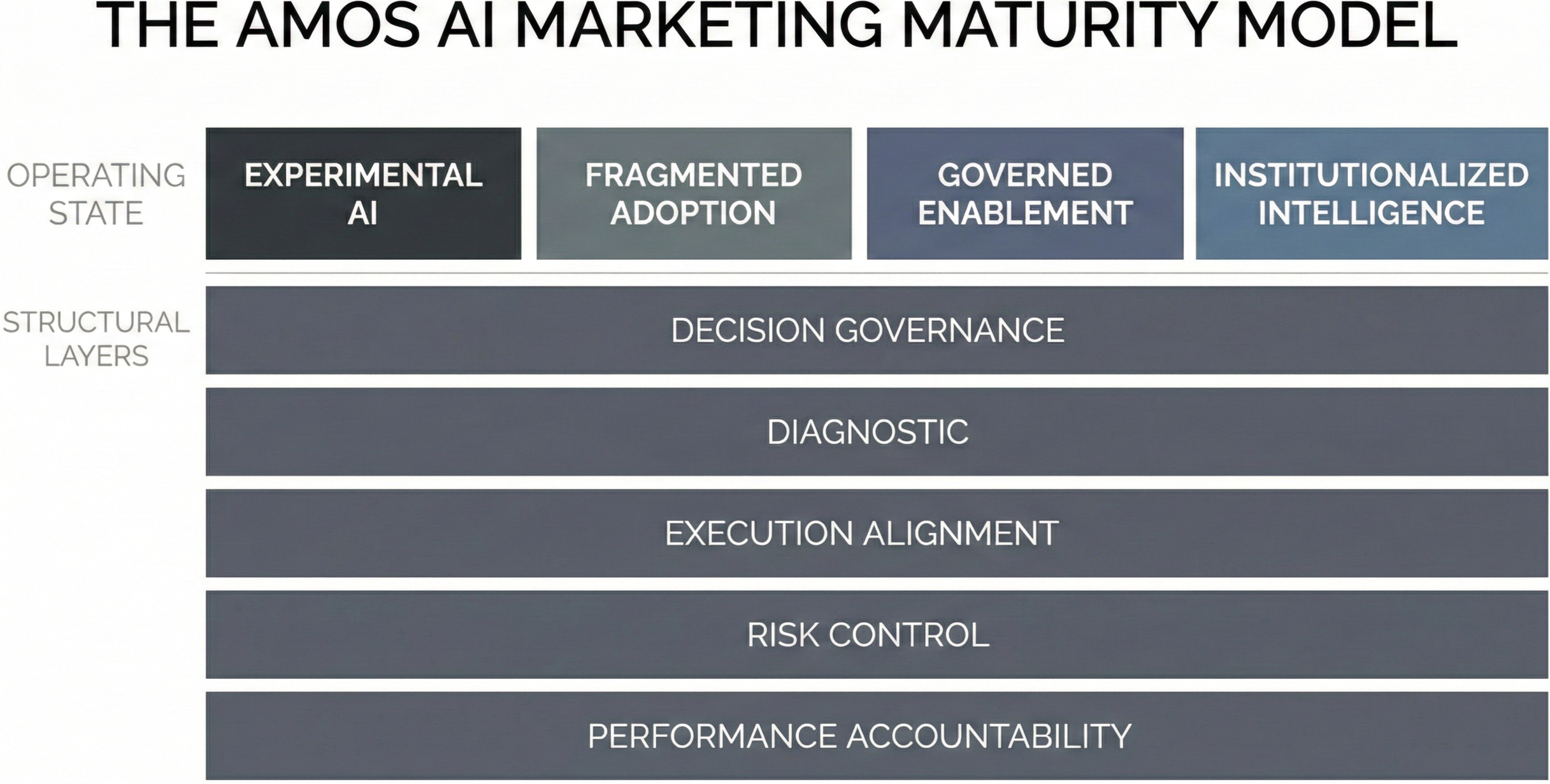
The AMOS Five-Layer Operating Model
AI maturity is not measured by automation volume. It is measured by operating discipline.
The AMOS framework defines five integrated structural layers that determine whether AI functions as an institutional capability or remains fragmented experimentation.
1. Decision Governance Layer
This layer defines authority, oversight, and escalation architecture. It answers:
• Who approves AI initiatives?
• Who defines success criteria?
• Who accepts risk exposure?
• Who has authority to reprioritize or terminate initiatives?
Without explicit decision rights, AI fragments across teams. Governance must define ownership at the executive level, not just operational responsibility.
2. Diagnostic Layer
The Diagnostic Layer determines readiness before execution begins. It evaluates:
• Data integrity and accessibility
• Workflow maturity
• Measurement consistency
• Talent capability
• Structural constraints
Diagnostic sequencing prevents premature implementation and reduces rework. AI initiatives launched without readiness evaluation amplify disorder rather than performance.
3. Execution Alignment Layer
Execution alignment ensures that AI initiatives map to defined growth priorities rather than opportunistic experimentation.
This layer standardizes:
• Scope definition
• Documentation requirements
• Integration criteria
• Approval checkpoints
AI initiatives should not bypass operating standards simply because they are innovative.
4. Risk Control Layer
AI introduces compliance, brand, data, and operational exposure.
The Risk Control Layer embeds:
• Scope gating protocols
• Review checkpoints
• Escalation pathways
• Auditability standards
• Formal decision records
Risk controls are not reactive safeguards. They are structural preconditions for scale.
5. Performance Accountability Layer
Performance accountability ties AI initiatives to executive-defined outcomes rather than vendor metrics.
This layer ensures:
• Clear success criteria
• Governance-aligned reporting
• Defined performance review cadence
• Investment continuation thresholds
Without accountability, AI becomes activity without institutional leverage.
These five layers function as an integrated system. When one layer is weak or absent, structural maturity degrades and scaling increases instability.
The Four Operating States of AI Marketing Maturity
AI marketing maturity is not progressive hype. It reflects structural condition.
Experimental AI
AI exists as isolated experiments without governance or sequencing.
Constraint: No decision authority framework.
Fragmented Adoption
Multiple AI initiatives exist across teams without unified oversight.
Constraint: Undefined decision rights and weak controls.
Governed Enablement
AI initiatives operate within defined governance, sequencing, and formal risk controls.
Constraint: Integration is structured but not yet institutionalized.
Institutionalized Intelligence
AI functions inside a fully integrated operating system where governance, sequencing, execution, and accountability are synchronized.
Constraint: Maintaining discipline at scale.
Why Most AI Marketing Initiatives Stall
AI initiatives rarely fail because of inadequate technology. They stall because structural governance is absent.
Common stall patterns include:
• Tool-first adoption without defined decision authority
• Undefined executive ownership
• Risk exposure identified after scaling
• Misaligned performance metrics
• No readiness assessment before investment
These are governance failures, not technical ones.
The structural governance architecture required to prevent these patterns is examined in detail in Why Most AI Marketing Initiatives Fail: The Missing Governance Layer.
Diagnostic-First Sequencing and Readiness
An AI marketing readiness assessment evaluates whether governance, sequencing discipline, risk controls, and executive alignment are sufficient to support scaling.
It does not evaluate tools.
It evaluates operating maturity.
Organizations operating in Experimental or Fragmented states require diagnostic-first sequencing before expansion.
The full readiness framework is detailed in Diagnostic-First AI Adoption: A Structured Alternative to Tool-First Strategy.
What This Means for CMOs
AI adoption is an operating decision.
Executive leaders must ensure:
Governance precedes scale
Sequencing precedes execution
Controls precede investment
Accountability precedes expansion
Maturity is structural. It is not technological.
Executive Summary
An AI marketing operating model governs how AI initiatives are prioritized, sequenced, and measured.
The AMOS framework includes five integrated operating layers.
Organizations function within four structural operating states.
Most AI failures result from governance gaps, not technical limitations.
Diagnostic-first sequencing reduces risk and prevents rework.
AI maturity is achieved through discipline, not speed.
Related Structural Reads:
• Measuring AI Marketing Maturity: How CMOs Assess Structural Progress
• AI in Marketing: Who Owns the Operating Model?
