
From Experimentation to Execution: How CMOs Build AI-Enabled Marketing Systems
The Leadership Inflection Point
Most AI initiatives in marketing begin at the edges.
A pilot in performance marketing.
A generative content experiment.
A predictive scoring enhancement.
Early wins create enthusiasm. Activity increases. Tools multiply.
But experimentation does not equal system capability.
The leadership inflection point occurs when the CMO recognizes that AI must move from isolated experimentation to governed execution. At this stage, the question shifts from “What can AI do?” to “How do we operationalize AI as a managed capability?”
This is not a tooling decision. It is an operating model decision.
What Is an AI-Enabled Marketing System?
An AI-enabled marketing system is a structured operating environment in which AI initiatives are prioritized, governed, sequenced, measured, and scaled under defined executive accountability.
It includes:
Decision rights
Portfolio governance
Risk controls
Performance instrumentation
Operating cadence
AI becomes a managed capability embedded within the marketing system, not an overlay of disconnected experiments.
Why Most Organizations Stall After Experimentation
After initial pilots, many organizations experience a plateau.
Common patterns emerge:
Multiple AI initiatives operating independently
Budget allocation driven by enthusiasm rather than prioritization
Inconsistent measurement standards
Undefined ownership of AI performance
Escalating risk exposure without formal oversight
The organization appears active, but structural maturity remains low.
This is the gap between experimentation and execution.
The Four Layers of an AI-Enabled Marketing System
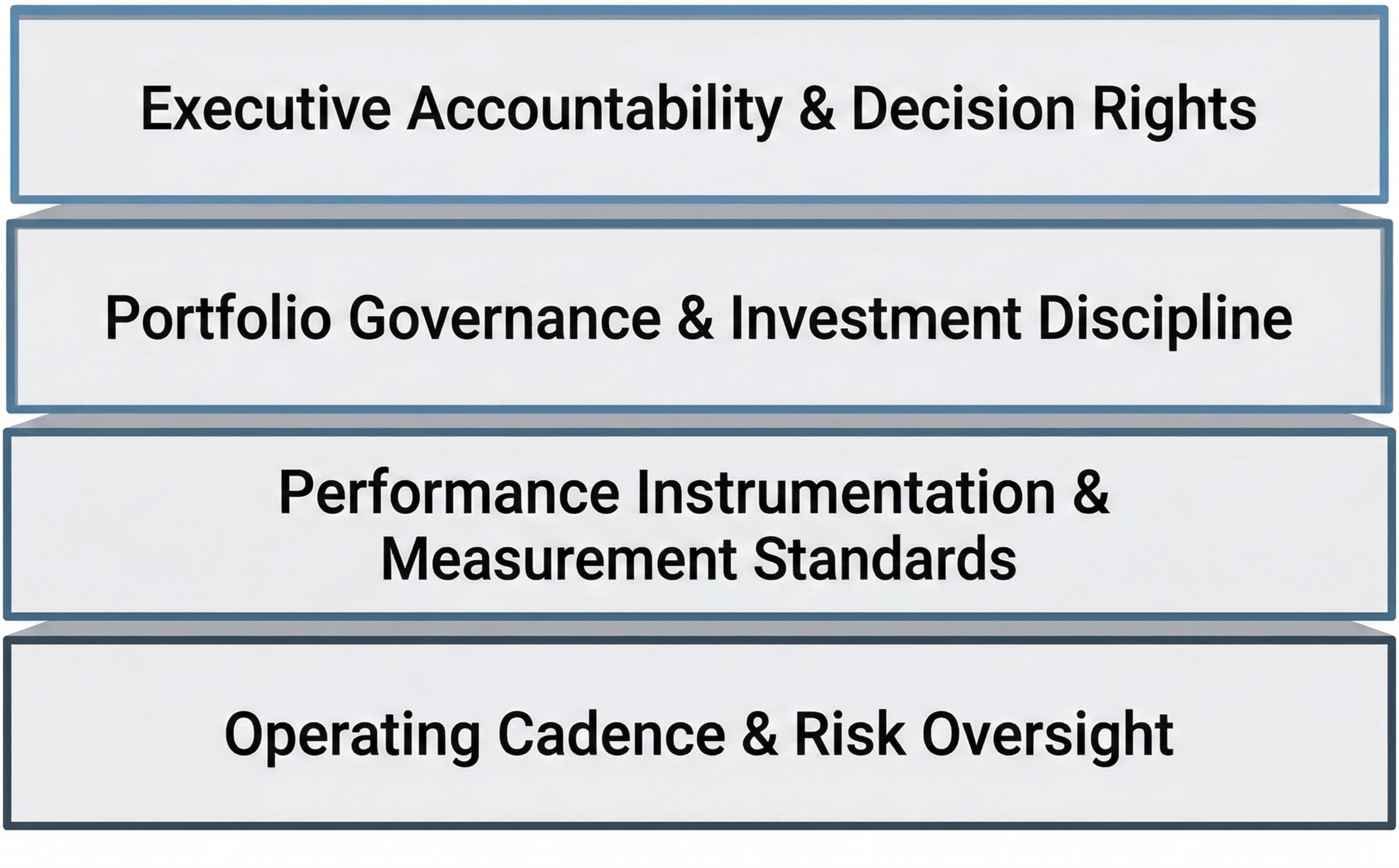
To move beyond experimentation, CMOs must design AI capability across four structural layers.
1. Executive Accountability and Decision Rights
AI investment must have clear ownership.
Define:
Who approves AI initiatives
Who owns performance outcomes
Who governs risk exposure
Who controls budget allocation
Without decision clarity, AI initiatives diffuse into ambiguity.
2. Portfolio Governance and Investment Discipline
AI initiatives should be managed as a portfolio, not as isolated projects.
Establish:
Prioritization criteria
Stage-gate approval processes
Sequenced rollout plans
Defined expansion thresholds
This ensures AI investments align with growth strategy rather than opportunistic adoption.
3. Performance Instrumentation and Measurement Standards
AI performance must be measured with the same rigor as channel investment.
Define:
Baseline benchmarks
Clear success metrics
Attribution standards
Ongoing performance audits
Execution requires instrumentation, not anecdotal evidence.
4. Operating Cadence and Risk Oversight
AI systems require recurring review.
Implement:
Governance review cycles
Risk monitoring checkpoints
Escalation pathways
Adjustment protocols
Operating cadence prevents drift.
The Executive Shift: From Innovation Sponsor to System Architect
The CMO’s role evolves as AI scales.
At early stages, leadership sponsors experimentation.
At maturity stages, leadership architects systems.
This shift requires:
Institutionalizing decision architecture
Aligning AI investments to strategic growth objectives
Embedding governance before scaling
Formalizing oversight structures
AI transformation is not a creative exercise. It is an operating discipline.
When CMOs Must Formalize an AI System
System design becomes urgent when:
AI pilots are multiplying across teams
Tool sprawl is increasing
Executive reporting lacks clarity
Risk oversight is informal
Budget discussions exceed tactical experimentation
At this stage, continued experimentation without structural alignment increases fragility.
Execution requires architecture.
Executive Summary
AI experimentation does not create system capability.
CMOs must shift from tool sponsorship to system architecture.
AI-enabled marketing systems require defined decision rights.
Portfolio governance ensures investment discipline.
Performance instrumentation enables accountability.
Operating cadence sustains execution maturity.
AI maturity is not achieved through expansion alone.
It is achieved through structural design.
