
Diagnostic-First AI Adoption: A Structured Alternative to Tool-First Strategy
The Structural Problem with Tool-First AI
Most AI adoption in marketing begins with enthusiasm.
A team identifies a promising tool.
A vendor demonstrates performance gains.
A pilot is launched.
The initiative may succeed tactically. It often fails structurally.
Tool-first AI adoption introduces capability before confirming readiness, sequencing authority, or defining governance controls. The result is familiar:
Fragmented experimentation
Inconsistent performance measurement
Hidden risk exposure
Erosion of executive confidence
AI does not fail because the tools are ineffective. It fails because adoption bypasses structural evaluation.
What Is a Diagnostic-First AI Adoption Model?
A diagnostic-first AI adoption model is a governance-based sequencing framework that evaluates organizational readiness, structural constraints, and executive decision alignment before AI capabilities are deployed.
It answers three questions before execution begins:
Are we structurally ready?
Are we sequenced correctly?
Are risks defined and controlled?
This approach shifts AI from experimentation to accountable capability development.
Why Tool-First Strategy Creates Structural Instability
When organizations adopt AI tools without diagnostic sequencing, four predictable patterns emerge:
1. Capability Overreach
AI is deployed in areas where data integrity, workflow maturity, or measurement discipline are insufficient to support it.
2. Decision Ambiguity
No clear ownership exists for prioritization, investment approval, or performance accountability.
3. Unmapped Constraints
Operational bottlenecks, compliance exposure, or integration limits surface only after deployment.
4. Scaling Before Governance
Early success leads to expansion without defined oversight architecture.
These are not implementation errors. They are sequencing errors.
The Three Dimensions of Diagnostic-First AI Adoption
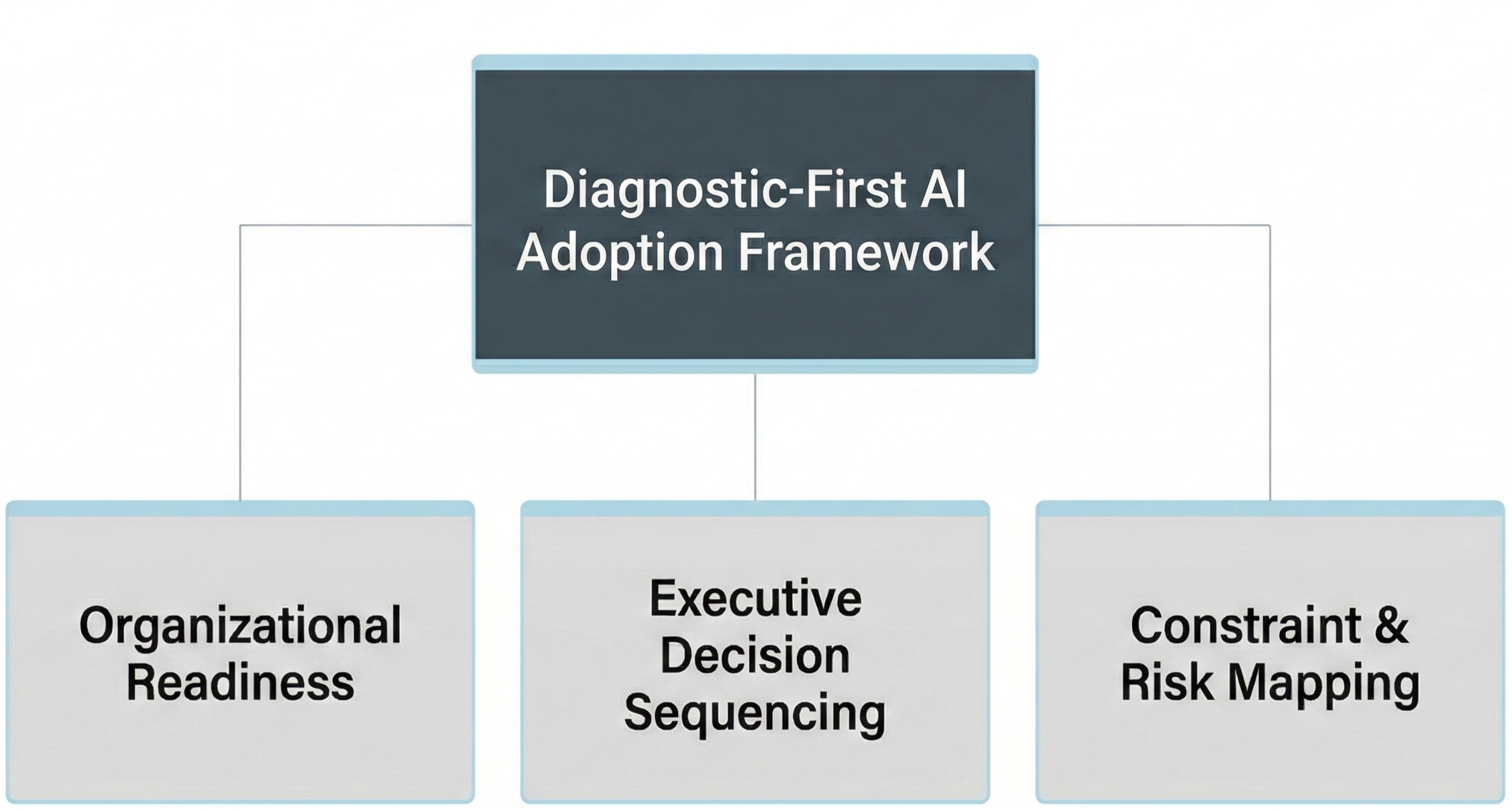
A structured diagnostic framework evaluates three dimensions before AI investment proceeds.
1. Organizational Readiness
Assess:
Data quality and accessibility
Measurement consistency
Workflow maturity
Talent capability
Technology integration health
Readiness determines whether AI accelerates performance or amplifies disorder.
2. Executive Decision Sequencing
Define:
AI investment prioritization criteria
Governance oversight structure
Budget allocation authority
Escalation pathways
Review cadence
Sequencing determines whether AI initiatives align with strategic growth priorities or operate independently.
3. Constraint and Risk Mapping
Identify:
Compliance exposure
Data privacy implications
Brand governance risks
Model volatility and bias concerns
Operational bottlenecks
Constraint mapping prevents risk discovery during scaling.
AI Marketing Readiness Scoring Framework
A diagnostic-first model requires measurable assessment criteria. Readiness cannot remain qualitative.
A structured AI marketing readiness evaluation should score organizations across five dimensions:
1. Data Integrity
Is performance data accessible, reliable, and consistently governed?
Are measurement definitions standardized across teams?
2. Workflow Maturity
Are marketing processes documented and repeatable?
Can AI integrate without disrupting operating stability?
3. Decision Governance
Are AI investment thresholds defined?
Are prioritization criteria explicit?
Is risk ownership assigned?
4. Risk and Compliance Controls
Are data privacy, brand governance, and compliance standards documented?
Are escalation pathways defined before deployment?
5. Executive Alignment
Is there clarity around strategic AI objectives?
Are success criteria tied to business outcomes rather than experimentation metrics?
Each dimension should be evaluated on a structured scale:
• Reactive (Ad Hoc)
• Emerging (Partially Defined)
• Structured (Documented and Governed)
• Institutionalized (Integrated and Measured)
Readiness is determined not by tool availability, but by structural maturity across these five dimensions.
Organizations scoring below “Structured” in multiple dimensions should not scale AI initiatives until structural gaps are addressed.
From Experimentation to Structured Capability Development
Diagnostic-first adoption reframes AI as an operating capability, not a tactical enhancement.
It introduces discipline before deployment.
The sequence becomes:
Evaluate structural readiness
Define decision architecture
Map constraints and risk exposure
Approve sequenced initiatives
Deploy under defined oversight
This approach does not slow innovation.
It prevents compounding instability.
What This Means for CMOs and Executive Leaders
For executive leaders, the central shift is conceptual:
AI should not be evaluated by what it can do.
It should be evaluated by whether the organization is prepared to absorb it.
Before approving AI expansion, leadership should ask:
Has readiness been formally assessed?
Are decision rights defined?
Have constraints been mapped?
Is governance embedded before scaling?
If these conditions are absent, acceleration introduces fragility.
When to Conduct an AI Marketing Diagnostic
A diagnostic assessment is required when:
Multiple AI pilots are underway
Tool sprawl is emerging
Performance attribution is inconsistent
Risk oversight is informal
Executive reporting lacks clarity
Diagnostic sequencing should precede expansion.
Without it, AI remains experimental.
With it, AI becomes structural.
Executive Summary
Tool-first AI adoption creates structural instability.
Diagnostic-first sequencing evaluates readiness before deployment.
Organizational readiness determines whether AI amplifies order or disorder.
Executive decision architecture must precede scaling.
Constraint mapping prevents risk discovery during expansion.
Governance-first sequencing converts AI into an operating capability.
AI maturity is not achieved through faster experimentation.
It is achieved through disciplined sequencing.
Related Structural Reads:
• The AI Marketing Operating Model: Why Tools Alone Do Not Create Maturity
• Measuring AI Marketing Maturity: How CMOs Assess Structural Progress
